Is My Website Ready for Readers That Aren't Human?
Google says optimising for AI search is simply SEO. An evening of reading on what actually changed, and what I checked on my own site.
I spent this evening reading about something I hadn't planned to. It started with a simple question about my own site: when someone asks an AI assistant about the topics I write on, would paulspov.com ever show up in the answer?
A few hours and far too many browser tabs later, I have a clearer picture. Most of what I read was noise: new acronyms, bold predictions, tools promising "AI visibility". A handful of things were actually worth my attention. These are the ones I'm keeping.
01.SEO, GEO, AEO: A New Label on the Same Substance
Everyone on LinkedIn seems to have a new acronym. GEO for generative engine optimisation, AEO for answer engines, and lately HEO for hybrid. In January I wrote that SEO is turning into GEO. I was ready to add a whole new discipline to my reading list.
Then I read about Google's own guidance from September. Its message is plain: the AI features in Search run on the same core ranking and quality systems as normal search. They pull pages from Google's index and link to the ones they rely on. To be cited, your content has to be eligible for Search and useful to people. That is SEO.
As a transfer pricing person, this felt familiar. In my world, renaming a transaction doesn't change how it's taxed. What counts is what the parties actually do, which the OECD calls accurate delineation. Optimising for AI search works the same way: the label is new, the substance test isn't.
02.Query Fan-Out: Why Your Page Gets Read in Pieces
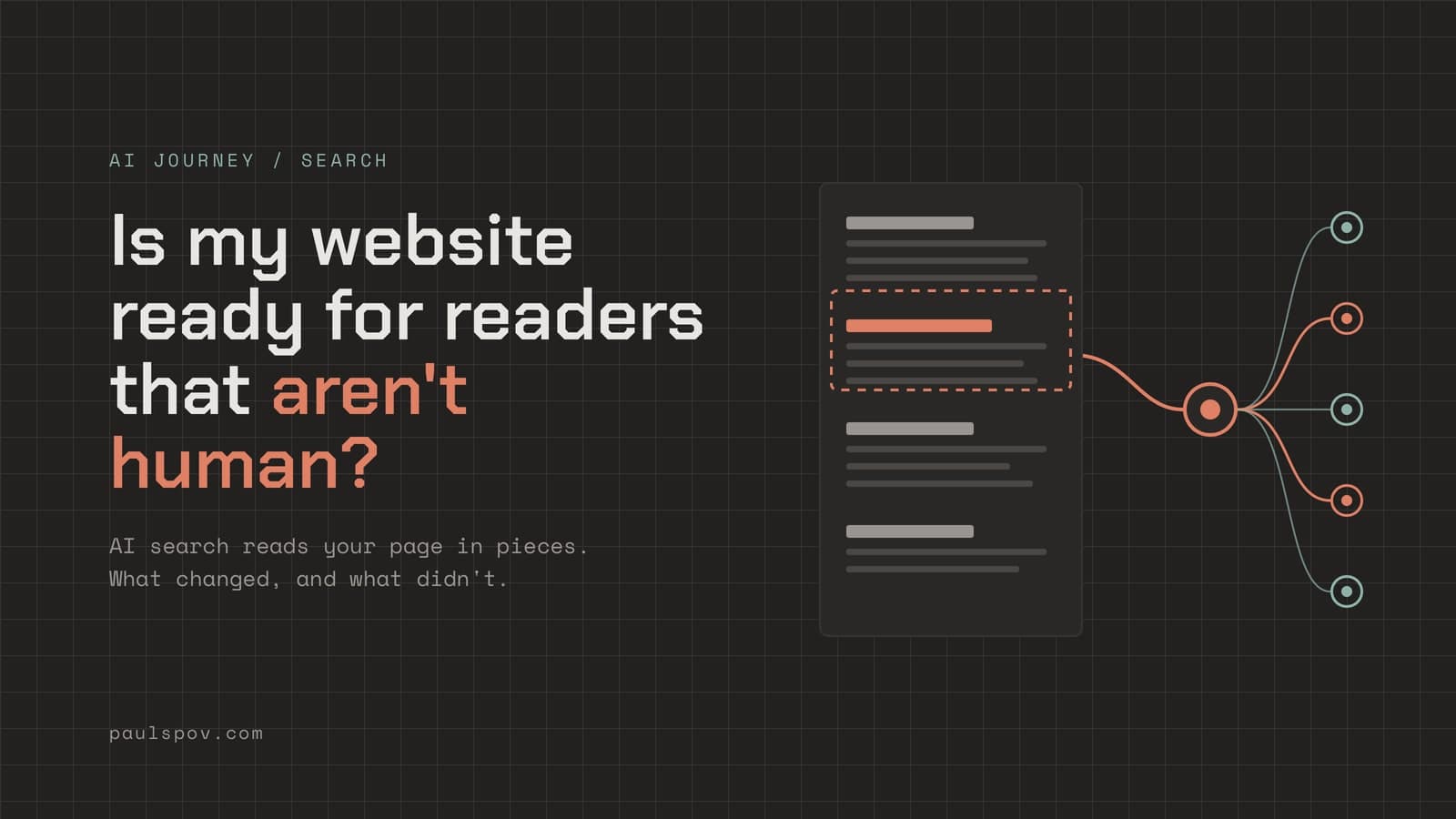
The one truly new idea I came across is query fan-out. When you ask Google's AI Mode a question, it doesn't run one search. It splits your question into smaller sub-questions, searches each in parallel, and stitches the results into one answer. One analysis I read puts it at 8 to 12 sub-queries per prompt. I can't verify that number, but Google itself describes the mechanism.
That changes how a page gets used. The AI isn't reading my article top to bottom like a person would. It's hunting for the paragraph that answers one narrow sub-question and lifting it out. So each section has to make sense on its own: a heading that says what follows, a first sentence that gives the answer, no "as mentioned above".
The irony is that this is just good writing. It's also how I was trained to draft client memos: conclusion first, reasoning after.
03.What I Checked on paulspov.com
I'm not a developer. I built this site with Cursor and Claude Code, so tonight I went through it with that checklist in hand. Most of the technical basics turned out to be in place already:
- Pages are rendered on the server. The article text is in the HTML before any JavaScript runs, so a crawler doesn't need to execute code to read it.
- Structured data is there. Every post carries Schema.org markup saying it is a blog post, who wrote it and when. It tells machines who is speaking.
- There is an llms.txt file. A plain guide for AI assistants listing what's on the site, which I wrote about in January.
- Sections that stand alone. This one depends on how I write, not on the code, so it's my homework from now on.
- Search Console. Since May, AI Mode impressions sit in the standard Performance report. Clicks aren't split out from regular web clicks, though, so I won't know exactly what AI search sends my way.
None of this is exotic. That's the point.
04.The Question Nobody Has Answered: Who Pays?
The part that kept me reading longest wasn't technical. Cloudflare has launched a Monetization Gateway that lets site owners charge AI agents for access to their pages, data, APIs and MCP tools.
My first reaction was as a writer: fair enough. If an AI answers a question using my thinking and the reader never visits, something is lost. My second reaction was as an adviser. Whenever a free flow becomes a priced one, the hard questions are about value and who captures it. That is literally my day job, and I suspect the web is heading for its own pricing debate.
I don't have a view yet on whether a small personal blog should charge anyone. For now, I'd rather be cited than paid.
Strip away the acronyms and the advice is old: write clearly, structure it well, make it easy to find, and say something worth quoting. I'll report back once I've written a few posts with the fan-out logic in mind and seen what, if anything, moves.
Sources